



YouTube says it will quickly cease offering knowledge to Billboard for inclusion within the US charts, ending a partnership that has lasted greater than a decade.

The choice, introduced at this time (December 17) by Lyor Cohen, YouTube’s International Head of Music, comes simply sooner or later after Billboard revealed adjustments to its chart methodology that may truly slim the weighting hole between paid and ad-supported streams.
Beneath Billboard’s present method for the Billboard 200, one album ‘unit’ equals 1,250 paid/subscription streams or 3,750 ad-supported streams — a 1:3 ratio.
Billboard’s new methodology, introduced yesterday (December 16), tightens that ratio to 1:2.5, with one album unit now equalling 1,000 paid streams or 2,500 ad-supported streams. (The identical ratio change is being utilized to the Scorching 100.)
In different phrases: paid streams will nonetheless be weighted extra favorably than ad-supported performs, however by a smaller margin than earlier than.
But in a press release at this time, Lyor Cohen stated the adjustments don’t go far sufficient. YouTube desires all streams to be counted equally on Billboard’s charts – no matter whether or not they come from paid subscriptions or ad-supported companies.
“Billboard makes use of an outdated method that weights subscription-supported streams increased than ad-supported,” Cohen stated in a press release.
“This doesn’t replicate how followers interact with music at this time and ignores the huge engagement from followers who don’t have a subscription.”
Cohen added: “We consider each fan issues and each play ought to rely equally, subsequently after January 16, YouTube knowledge will not be delivered or factored into the US Billboard charts.”
That January 16 date is deliberate: the brand new Billboard streaming methodology takes impact with charts dated January 17, 2026 (protecting knowledge from January 2-8).
Added Cohen: “Streaming is the first manner individuals expertise music, making up 84% of US recorded music income.
“We’re merely asking that each stream is counted pretty and equally, whether or not it’s subscription-based or ad-supported—as a result of each fan issues and each play ought to rely.”
YouTube was first included within the Billboard Scorching 100 in February 2013, and was later added to the Billboard 200 album chart in January 2020.
“After a decade-long partnership and in depth discussions, [Billboard] are unwilling to make significant adjustments,” Cohen stated. “We’re dedicated to attaining equitable illustration throughout the charts and hopefully can work with Billboard to return to theirs.”
2018: Billboard suggestions the scales towards paid
The query of the right way to weight several types of streams has been contested since Billboard first launched tiered streaming values in 2018.
Previous to that change, all streams — whether or not from paid companies like Apple Music or ad-supported platforms like YouTube — had been counted equally.
In a 2017 interview with MBW, Apple‘s Jimmy Iovine argued that having YouTube streams rely equally alongside paid-for music on Billboard’s Scorching 100 deprived artists.
Iovine was unequivocal about his view that paid streams ought to carry extra weight on trade charts. “I’ll put it this manner: individuals who pay for subscriptions needs to be advantaged,” he stated. “The labels owe it to their prospects.”
He added: “A very powerful factor for labels is to make the paid companies compelling and entertaining. And don’t make free companies nearly as good because the paid companies. Is that not apparent?!“
When the 2018 adjustments had been applied, paid subscription streams had been weighted extra closely than ad-supported streams on each charts.
On the Scorching 100, paid streams got full level worth, ad-supported streams two-thirds, and programmed streams half. On the Billboard 200, it took thrice as many ad-supported streams (3,750) as paid streams (1,250) to equal one album unit.
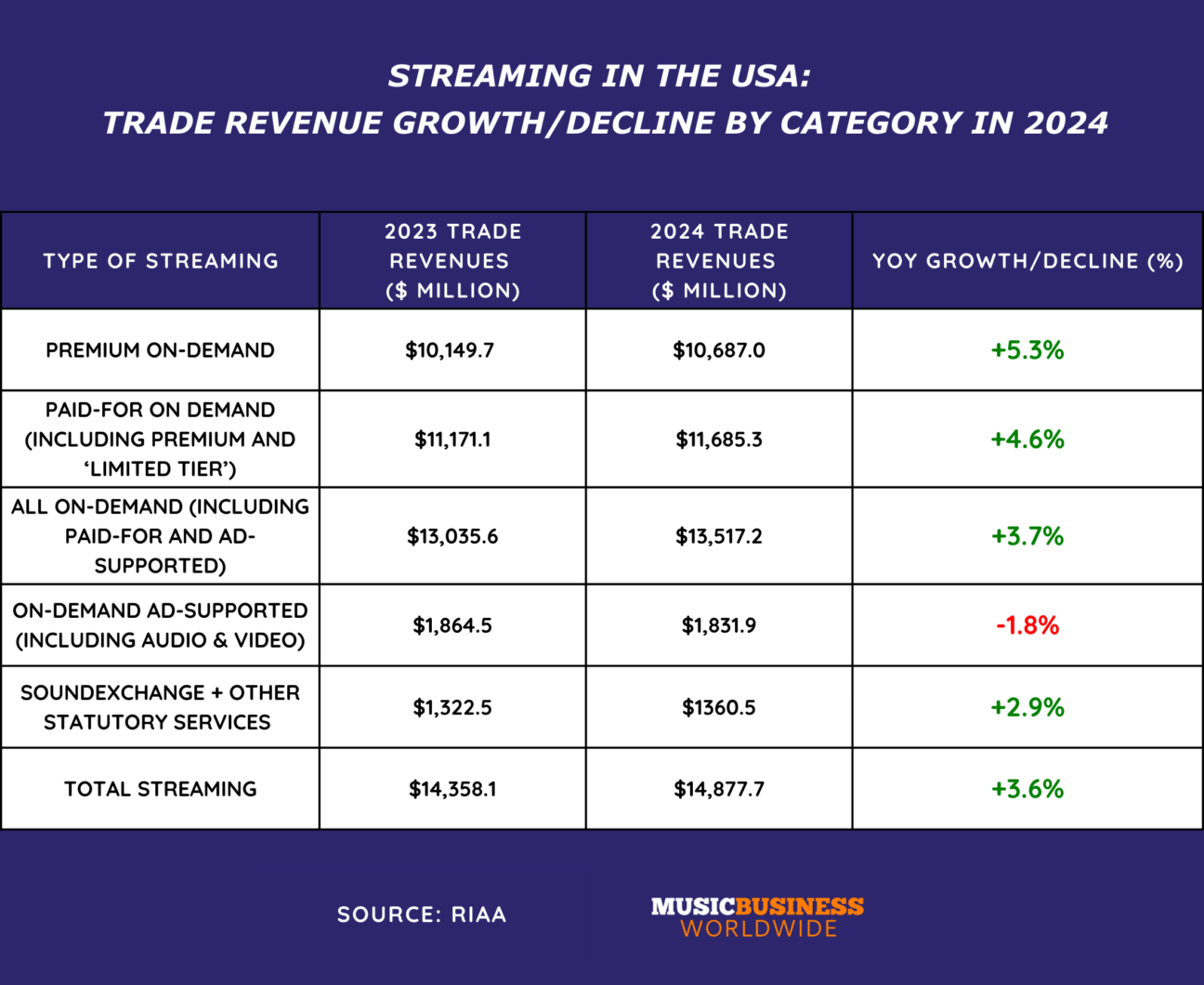
Latest knowledge reveals that the US recorded music trade’s general streaming income efficiency in 2024 was dragged down by payouts from on-demand, ad-supported music companies, together with YouTube and Spotify‘s ‘freemium’ tier.
Mixed, these platforms noticed their income contribution to the recorded music trade decline within the US final yr, down 1.8% YoY to $1.83 billion.
In the meantime, on-demand paid subscription platforms contributed $11.685 billion to recorded music rightsholders, up 4.6% YoY.
The disparity in income per stream between paid and free tiers is on the coronary heart of the talk.
As Iovine put it in 2017: “The very fact is that ‘free’ in music streaming is so technically good and ubiquitous that it’s stunting the expansion of paid streaming. Two issues must occur: free has to turn out to be tougher or restricted, and the paid companies must get higher.”
Cohen’s announcement represents a reversal from 2019, when he welcomed YouTube’s inclusion within the Billboard 200, calling it a “crucial second in making the chart a extra correct illustration of what individuals are listening to.”
At the moment, Cohen stated: “Genres like Latin, hip-hop and digital, which constantly dominate the YouTube charts, will now be correctly acknowledged for his or her recognition. That is one other nice step in bringing YouTube and the trade collectively.”
YouTube reported in October that it paid greater than $8 billion to the music trade through the 12 months from July 2024 to June 2025, protecting income from each promoting and subscriptions on the Google-owned platform.
In his assertion at this time (December 17), Cohen directed followers to YouTube’s personal charts as an alternative choice to Billboard’s lists.
“In case you’re interested by what music is making waves on YouTube, you may go to our charts,” he stated.
Music Enterprise Worldwide