


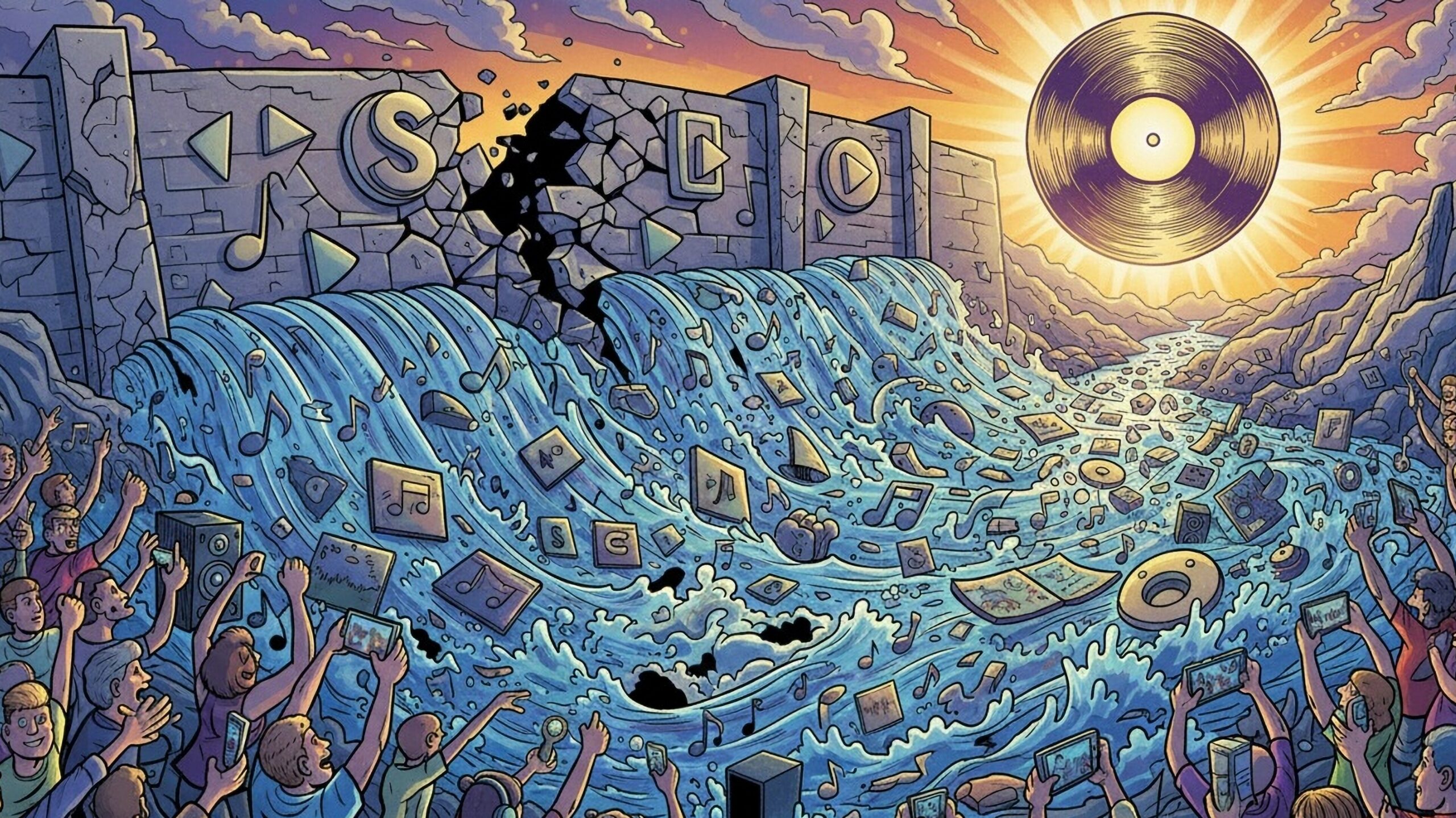
There have been 253 million music tracks sitting on audio streaming companies on the shut of 2025.
Yep: over quarter of a billion. Some milestone.
In line with new knowledge from Luminate’s new annual report, that was up by 37.9 million tracks YoY – a mean of 106,000 uploads per day.
Most of this music was removed from common:
- Virtually half of the 253 million recordsdata (120.5 million) hosted by audio platforms acquired fewer than ten streams final 12 months.
- Virtually three-quarters of it (73%) acquired fewer than 100 annual streams.
- And almost nine-tenths of it (88%) acquired fewer than 1,000 annual streams.
We’re clearly a protracted, great distance from Apple‘s promise to ship “1,000 songs in your pocket” with the iPod.
As AI-generated music proliferates, are we now just some brief years from the likes of Spotify internet hosting “1 billion songs in your pocket”?
And wouldn’t such a tidal wave of content material inevitably swamp digital companies – whereas hurting artists, songwriters, and the perceived worth of music amongst shoppers?
Common Music Group CEO and Chairman, Sir Lucian Grainge, actually thinks so… and he’s eager to cease it occurring.
Final week, Grainge delivered a stark warning about AI-generated content material overwhelming streaming platforms in his 2026 New 12 months deal with.
“Validating enterprise fashions that fail to respect artists’ work and creativity, and promote the exponential development of AI slop on streaming platforms, is a grave disservice to artists, songwriters and all of us who work in music,” Grainge wrote.
This warning wasn’t theoretical.
Final 12 months, Spotify eliminated over 75 million ‘spammy tracks’ from its platform, whereas rival Deezer reported receiving 50,000 totally AI-generated tracks per day by November – accounting for 34% of all each day uploads.
But regardless of this aggressive purging of content material the whole quantity of music within the world audio-streaming ecosystem continued to soar in 2025.
Dialogue round tracks that entice fewer than 1,000 streams per 12 months is, in fact, significantly related right here.
Luminate‘s new numbers assist illustrate why – with UMG’s encouragement – audio streaming companies moved in the direction of ‘artist-centric’-style fee fashions a few years in the past… and why these fashions are actually more and more being stress-tested by AI.
In early 2024, Spotify launched a threshold requiring tracks to draw no less than 1,000 performs in a 12–month interval to qualify for royalty payouts.
On the time, Spotify mentioned 99.5% of streams on its platform went to tracks exceeding the 1,000 annual streams threshold. Beneath its new coverage, it mentioned, every of these tracks would earn extra — with payouts beforehand going to sub-1,000-stream tracks redirected again into the royalty pool.
Deezer’s artist-centric mannequin, launched in partnership with Common and Warner, achieved an analogous purpose – offering a “double increase” in royalties to artists with a minimal of 1,000 streams monthly and 500 distinctive listeners.
In his newest 2026 memo, Sir Lucian Grainge credited UMG’s ‘artist-centric’ initiatives with precisely predicting – and stemming – “the dramatic enhance within the quantity of irrelevant uploads, together with the rise of AI ‘slop’.”
But the subject stays divisive.
Some argue that it’s time for Spotify’s 1,000-per-year minimal stream payout threshold to be raised even increased.
Others – together with TuneCore proprietor Consider – contend such fashions symbolize an unfair system “centered round taking compensation from rising artists to allocate it to prime and established artists.”
The brand new Luminate report, which you’ll be able to obtain right here, calculates that there was “a mean of 106,000 new ISRCs [tracks] delivered to streaming companies every day in 2025,” up +7% from the 99,000 delivered each day in 2024.

The place the expansion is de facto coming from
Some of the hanging revelations in Luminate’s new knowledge is the dramatic shift in who’s importing music.
Tracks distributed by main music corporations – Common Music Group, Sony Music Leisure, Warner Music Group, and their affiliated ‘indie’ distribution arms – accounted for simply 3.8% of ISRC deliveries to DSPs in 2025.
That surprisingly small market share was lower than half the dimensions of the equal main market share determine in 2024 (8%), says Luminate.
Conversely, unbiased and DIY distribution represented a staggering 96.2% of each day uploads final 12 months – a determine that some within the trade more and more hyperlink to the explosion of AI-generated content material and automatic add methods.

Whereas 88% of tracks acquired 1,000 or fewer performs in 2025, Luminate’s knowledge reveals these tracks contribute virtually nothing to precise streaming consumption (as illustrated by the chart under).
Simply 541,000 tracks within the 1 million-50 million annual streaming bracket – representing barely 0.2% of all out there music – accounted for half (49.4%) of complete world audio streaming consumption final 12 months.
Tracks performed between 1 million and 10 million occasions alone generated 1.35 trillion streams.

Amid the deluge of low-engagement content material, Luminate’s knowledge does reveal some encouraging indicators.
An extra 1.9 million tracks reached the 1,000+ streams threshold in 2025 in comparison with 2024.
At increased tiers, 6,800 further tracks reached no less than 10 million streams (65.6K complete), and 1,000 extra tracks hit 50 million+ streams (5.0K complete).
Nonetheless, the variety of tracks reaching 1 billion streams really declined barely to 29 in 2025 from 33 in 2024 – suggesting that whereas the center tier is rising, superstar-level success stays intensely concentrated.
Music Enterprise Worldwide